The story of Lyrestads Gjuteri, part 2
A foundry takes shape
When Valter Stridkvist stepped off the train in Lyrestad in the summer of 1955, he knew he wanted to break ground, but not how it would all work. He had no factory. No equipment. Just a clear goal and the will to build something from scratch.

A foundry built from old contacts, borrowed money and its own bricks
What there was: a plot of industrial land, an eager local heritage society, and access to raw materials. The site was perfect, along the Göta Canal and close to the railway and road. The municipality, the property company and a few private backers helped with land, contacts and modest loans. The land cost 400 kronor. The property company stood guarantor.
Valter got the go-ahead. And the building began.
He drew the foundry himself. The cupola furnace, the heart of any foundry at the time, he ordered in sections from a relative in Månsarp. It was bricked up on site, lined with firebrick and fitted with fans. Inside it measured 110 centimetres. Enough to melt iron, if not much at a time.
The overhead crane, the backbone of production, was built from beams by Åke "Smé" in Böckersboda. Hoists and chains came from Månsarps Mekaniska. Machines were bought second-hand. No fancy equipment. Just what was needed, and what they could get hold of.
"We slept in the car, a Borgward Isabella!" Valter remembers.
"We drove around looking for customers in southern Dalarna, Västmanland, Örebro…"
Times were hard in the trade. One foundry after another went bankrupt. But Valter and Allan kept going. Kept at it. Made contacts. Laid the foundation for something that would last longer than many others.

The first iron, the first sweat
During the winter of 1955–56, everything was getting close to starting. The floor was cast. The machines were in place. But it was all still makeshift. Some days they burned wood for heat and kept building while they melted.
Allan Levinsson moved to Lyrestad with his family that spring. His wife and Valter's wife, Anna-Maria, helped out when needed with simpler jobs, sometimes packing, pouring and sorting. A real family business from the start.
And then,
on 5 April 1956, the first iron was poured.
"We had to be careful, we couldn't tip it all in at once," Anna-Maria laughed later.
"Everything was ready. Piles of pig iron, moulding sand, coke and limestone. They'd put it in piles for us. We just had to get it over the edge."
It was modest and simple, but it worked.
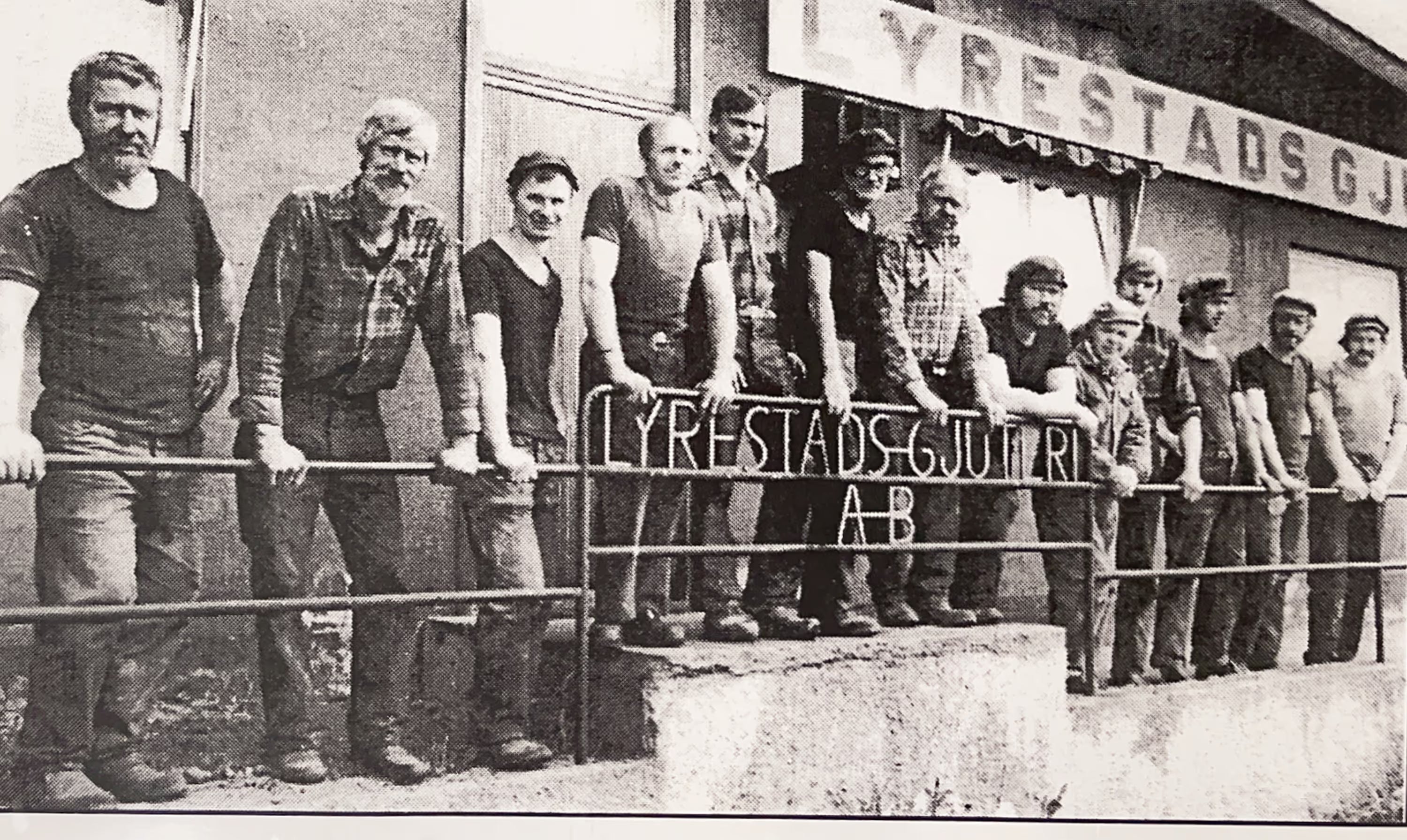
Valter, Allan and the people closest to them had built a working iron foundry with their own hands, with help from neighbours and friends, and a great deal of trust.
 Written by Andreas Stridkvist, with facts and inspiration from the book Lyrestads Gjuteri AB – Ett Familjeföretag by Owe E. Hermansson, 1997.